As we navigate the second decade of the 21st century, technology continues to blaze trails in every societal sector, shaping the world in previously unimaginable ways. Nowhere is this shift more evident than in the realm of education, where the integration of technology is revolutionizing teaching methodologies and learning environments.
The New Face of Learning with Artificial Intelligence
Just as artificial intelligence (AI) has found its place in various industries, it is poised to create significant educational breakthroughs. AI-powered systems have the potential to offer personalized learning experiences, recognizing each student’s strengths and weaknesses and maximize learning efficiency. For instance, Intelligent Tutoring Systems (ITSs) embody this potential, providing one-on-one instruction tailored to a learner’s specific needs without draining the resources of human educators.
Unlocking Potential with Blockchain Technology
The blockchain, initially designed for cryptocurrency transactions, has seen its usability extend to the education sector with promising prospects. Universities are starting to use blockchain to securely store and verify student credentials, which simplifies and expedites verification processes. Moreover, blockchain opens up the potential for learner-managed lifelong learning records, offering individuals more ownership and flexibility over their learning journeys.
Securing the Future of Education Through Cybersecurity
As educational institutions increasingly digitalize their platforms and services, they also become more vulnerable to cyber threats. Therefore, integrating cybersecurity practices into education is crucial. It’s essential that schools not only prioritize the security of their digital systems but also teach students about responsible digital citizenship. Cybersecurity education can empower students to navigate the digital world safely while understanding the potential consequences of irresponsible online behavior.
Towards a Connected Future with the Internet of Things
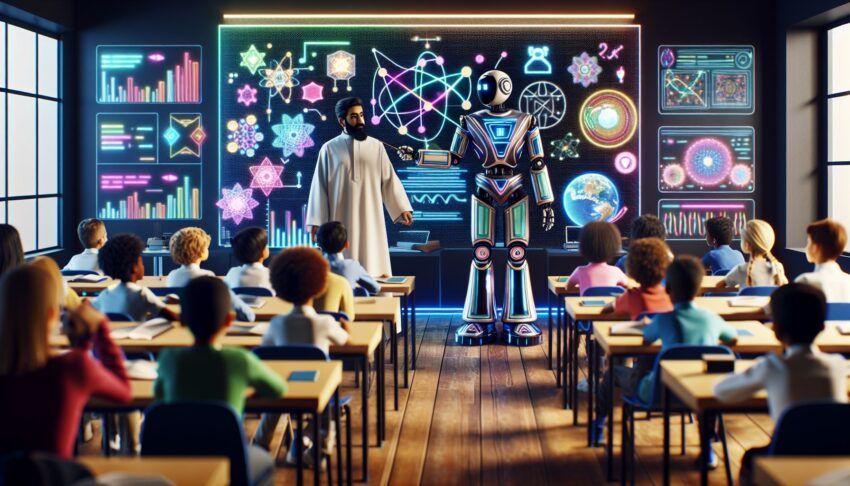
The Internet of Things (IoT) is another technological phenomenon set to transform education. IoT can foster a learning environment that is collaborative, intuitive, and responsive. Connected classrooms can auto-adjust conditions such as lighting and temperature, improving student comfort and concentration. Furthermore, IoT-enabled tools such as interactive whiteboards can encourage collaborative learning and improve student engagement.
Synthesizing a New Chapter in Education
Technology, in all its versatile glory, has set the stage for a new era of education. With the integration of AI, we’re seeing an innovative approach to personalization of the education experience. The application of blockchain technology is fundamentally changing the way we view student credentials, and cybersecurity developments are now essential to ensure the safety and integrity of the digital classroom. Finally, the Internet of Things presents a promising future of connected classrooms that are more interactive and engaging.
While these advancements offer exciting possibilities, they are not without challenges. It’s crucial that as we move forward, we consider societal accessibility, ensuring no one is left behind in the pursuit of this technologically advanced education paradigm. The future of education demands a careful balance of embracing these technological opportunities while tackling the associated challenges head-on. One thing’s valid though; regardless of what the future holds, the landscape of learning will never stop evolving. We can only venture to navigate these waves of change and ride the tide towards an improved education for all.